
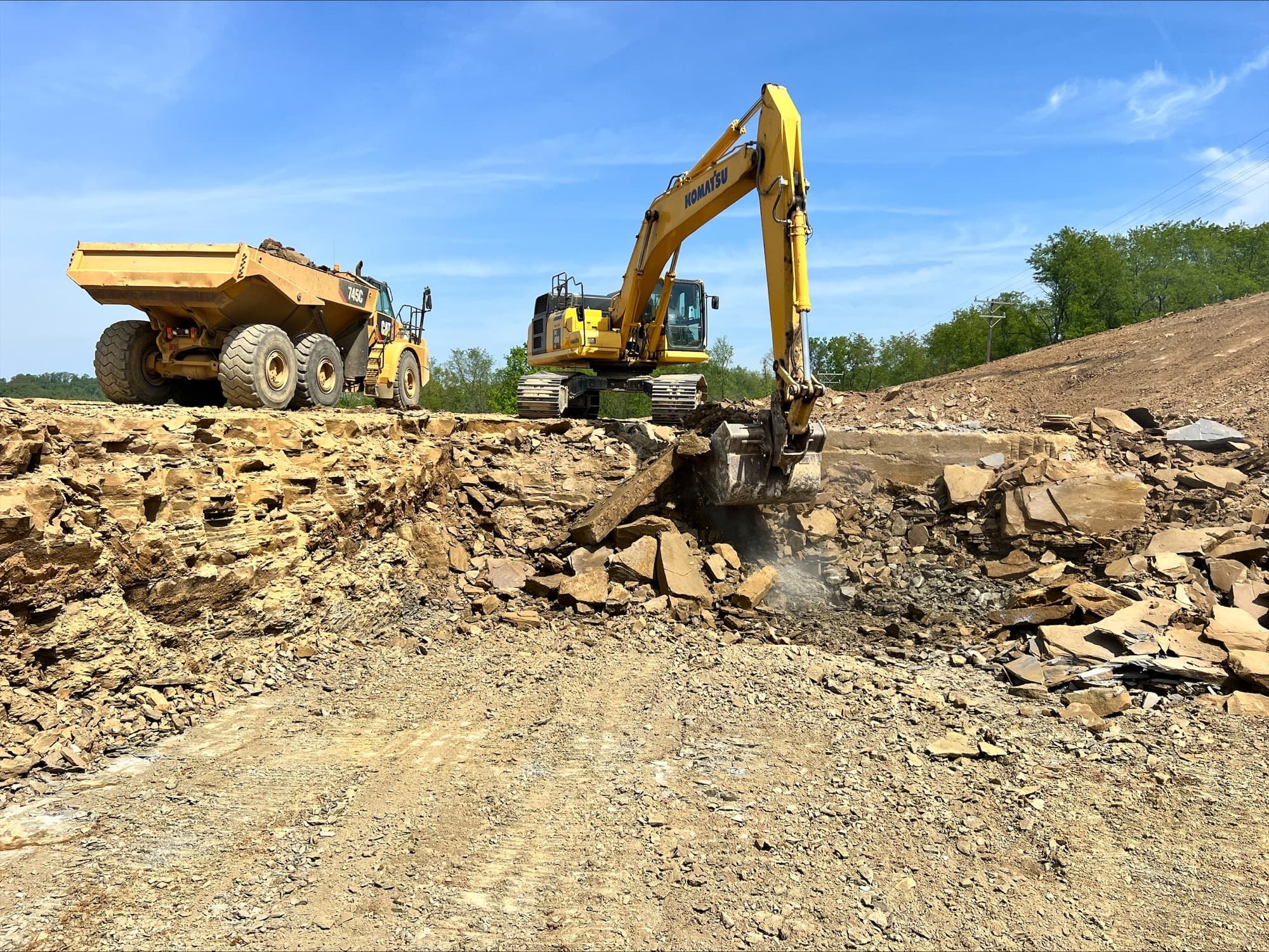
Oil and gas infrastructure construction covers site development, foundations, mechanical systems, pipe fabrication, pipeline installation, and commissioning, then a transition into operations and maintenance. In practice that means building compressor stations, metering and regulation facilities, gathering-line tie-ins, and skid-mounted assemblies that move natural gas from the wellhead to market.
It sounds linear. It rarely is. Terrain, live infrastructure, weather windows, and permitting all press on the schedule at once.
This guide breaks down the phases, the Appalachian realities, and how operators separate reliable contractors from the rest.
What Does Oil and Gas Infrastructure Construction Involve?
Oil and gas infrastructure construction involves everything required to turn a permitted site into a functioning midstream asset: clearing and grading, foundations, mechanical and piping systems, fabrication, pipeline installation, pressure testing, and startup. The scope ends when the facility is commissioned and handed to operations.
The core scope of a midstream build
A typical midstream build stacks several disciplines on top of each other. Compressor stations, metering and regulation packages, pipeline tie-ins, and skid-mounted assemblies all have to arrive, fit, and function together.
The U.S. pipeline construction market alone runs into the tens of billions annually, and the broader oil and gas pipeline and related structures construction sector was projected around $321 billion globally by 2025 (TBRC via GlobeNewswire). That scale reflects how much steel, concrete, and coordination each facility demands.
Why construction quality shapes long-term cost
Construction execution directly drives operational reliability. A poorly set foundation, a sloppy weld, or a rushed tie-in creates maintenance headaches and safety exposure that surface years later.
The team that builds it badly is rarely the team that pays for it later. The operator does.
Midstream operators know this. They evaluate contractors on coordination risk, schedule discipline, safety culture, and how the asset performs after handoff. ShalePro operates, maintains, and builds critical infrastructure across the Appalachian Basin, serving natural gas operators, power generation, and industrial clients.
What Are the Phases From Site Prep to Commissioning?
The phases run from civil and site development through foundations, mechanical construction, fabrication, pipeline installation, and finally commissioning. Fabrication often runs concurrent with civil work to compress the overall timeline.
Civil, site development, and foundations
Civil work comes first: access roads, grading, stormwater and erosion control, and laydown areas for equipment staging. Get this wrong and every trade behind it slips.
Foundations follow. Helical piles are common for compressor pads, metering skids, and facilities on steep grades or poor soils. They screw into the ground, carry load immediately, and skip the concrete cure wait, which matters when the schedule is tight and the terrain is bad. The Deep Foundations Institute (DFI) publishes practice guidance on helical pile design and installation.
Mechanical construction and fabrication
Mechanical construction sets the compressors, builds the piping systems, ties into existing gathering lines, and installs metering and regulation equipment. Process piping follows ASME B31 codes (ASME), and welds are qualified to AWS standards (AWS) with nondestructive testing to confirm integrity (ASNT).
Fabrication happens in parallel. Skid-mounted assemblies and piping spools built in a controlled shop come out more consistent than anything field fabricated, and they cut on-site time. ShalePro performs civil construction, helical pile installation, mechanical construction, and pipe fabrication at its West Alexander, PA shop and yard, all in-house.
Pipeline installation, pigging, and startup
Pipeline work covers new laterals, hot taps on live systems, pressure testing, and commissioning. Interstate lines fall under PHMSA safety rules (PHMSA), and pigging cleans and verifies the line before gas moves.
Then the asset transitions to operations: startup, performance validation, and handoff. When the constructor also operates the asset, that handoff is less a wall and more a continuation.
What Makes Appalachian Basin Construction Different?
Appalachian construction is defined by steep terrain, narrow right-of-way corridors, tight seasonal windows, and layered environmental permitting. The Marcellus and Utica sit under some of the most rugged ground in the country.
Terrain, weather, and permitting
Steep grades and limited access in Pennsylvania and West Virginia demand specialized equipment and operators who have run it before. A national crew unfamiliar with the ridges loses days learning what a local crew already knows in its sleep.
Permitting adds another layer. Erosion and sediment control, stream crossings, and air compliance run through Pennsylvania DEP (PA DEP), state agencies, and EPA emissions rules for oil and gas operations (EPA). Weather compresses the calendar further, with winter freeze-thaw and spring mud both eating access.
Working around live infrastructure
Much of this work happens around producing wells and active gathering systems. Hot taps and live-pipeline tie-ins carry real risk, and they demand crews with safety discipline built in.
Regional crew density is the quiet advantage here. Fast mobilization, 24/7 emergency response, and familiarity with local permitting authorities separate regional contractors from national players parachuting in. ShalePro runs seven locations across Pennsylvania, West Virginia, Virginia, and Tennessee with 24/7 emergency response and crews positioned across the field, managing hundreds of compressors and pipeline networks.
Turnkey Provider vs. Subcontractor Coordination: Which Works Better?
A turnkey provider that self-performs civil, mechanical, fabrication, and O&M generally outperforms a stack of separate subcontractors on schedule, accountability, and warranty. Fewer handoffs means fewer places for the project to stall.
The coordination and warranty problem
Separate civil, mechanical, and fabrication vendors create schedule dependencies and finger-pointing. When something goes wrong at commissioning, the civil contractor blames the mechanical crew, the mechanical crew blames the fabricator, and the operator sits in the middle.
Warranty gaps live in those seams. No single party owns the whole system.
One accountable team through the lifecycle
An in-house team removes the seams. Here is what that changes:
- Coordination collapses into one project manager instead of three vendor interfaces.
- Cost drops as stacked subcontractor markups disappear.
- Knowledge continuity means the crew that built the asset already understands it when an issue surfaces during commissioning or operations.
- Accountability stays with one team through startup and beyond.
| Factor | Turnkey self-perform | Multi-vendor coordination |
|---|---|---|
| Schedule risk | Lower, one team sequences work | Higher, handoff dependencies |
| Warranty | Single point of ownership | Gaps between trade scopes |
| Troubleshooting | Builder knows the system | Requires re-learning |
| Cost structure | Fewer markup layers | Stacked subcontractor margins |
ShalePro performs its services in-house, so a client works with one accountable team from site preparation through long-term maintenance, then transitions builds to compressor operations, pipeline services, and well tending. turnkey mechanical construction services
How Do You Verify a Construction Contractor's Safety?
Verify safety through leading indicators. Ask about field observation cadence, tailgate discipline, Job Safety Analysis rigor, and near-miss reporting, then confirm certifications as a baseline.
Leading indicators over lagging numbers
Lagging indicators like incident rates have real limits. Small sample sizes swing the math, reporting varies between companies, and a clean number tells you little about the culture underneath it.
Leading indicators reveal more. How often do crews run field observations? Are daily tailgate meetings a habit or a checkbox? Does the JSA actually shape the work? A dedicated safety team in the field, not just a compliance coordinator at a desk, signals genuine commitment.
ShalePro runs daily tailgate meetings, thorough Job Safety Analyses, and a dedicated safety and training team that logs more than 500 field safety observations every quarter. That team runs observations, incident management, and compliance rather than leaving it to the client, which keeps incident metrics in the industry-preferred range.
Certifications as table stakes
Certifications are the floor. Look for ISNetworld Certified, Veriforce Preferred, DOT Compliant, OSHA Compliant, and Veriforce SafeLandUSA trained crews.
OSHA maintains the oil and gas extraction safety standards these programs align to (OSHA). Credentials confirm a contractor can bid the work. The program behind them tells you whether they should. field safety program overview
How Should Operators Evaluate Construction Contractors?
Operators should evaluate contractors on in-house capability breadth, regional presence, safety program depth, references, and constructor-to-operator capability. Those five criteria predict execution better than a low bid ever will.
A practical vendor selection checklist
Work through these before awarding:
In-house capability breadth: can they self-perform civil, mechanical, fabrication, and O&M, or do they subcontract the trades? Regional presence: where are the crews, shops, and yards, and how fast can they respond to emergencies or change orders? Safety program depth: ask specifically about leading indicators, observation frequency, and dedicated field safety personnel. References and relationship duration: long-term partnerships signal reliable execution more than a polished pitch. Constructor-to-operator capability: will the team that builds it stay to operate and maintain it?
References and constructor-to-operator capability
Real operator feedback carries weight. Sam at Expand Energy credits ShalePro for consistently executing complex facility construction projects with a strong focus on quality, safety, and schedule.
Duration matters too. Brendan Burke, Vice President of Production at Seneca Resources, calls ShalePro a trusted partner for over a decade, consistently delivering well tending and roustabout services.
ShalePro Energy Services is an energy and industrial services company serving the Appalachian Basin from Houston, Pennsylvania, specializing in mechanical construction, pipe fabrication, helical pile installation, and midstream operations and maintenance. Its operating heritage dates to 1994. helical pile installation services
Frequently Asked Questions
What contractors handle oil and gas infrastructure construction in the Appalachian Basin?
Regional turnkey providers serve the Marcellus and Utica best. ShalePro Energy Services, headquartered in Houston, Pennsylvania, builds and operates midstream infrastructure across seven locations in Pennsylvania, West Virginia, Virginia, and Tennessee, with crews positioned across the field for 24/7 emergency response and fast mobilization.
How long does midstream facility construction take?
Timelines vary by scope. A compressor station or midstream facility typically involves weeks of civil and foundation work, concurrent shop fabrication, several weeks of on-site mechanical installation and piping, then commissioning. Regional contractors with nearby fabrication shops and staged crews compress those schedules meaningfully compared with national firms.
What safety certifications matter for pipeline construction contractors?
Look for ISNetworld, Veriforce Preferred, DOT compliance, OSHA compliance, and Veriforce SafeLandUSA trained crews. These are table stakes. Beyond credentials, verify a leading-indicator program with regular field observations, daily tailgate meetings, thorough Job Safety Analyses, and a dedicated safety team in the field rather than back-office only.
Can one company handle both construction and long-term O&M?
Yes. Constructor-operators build the asset then operate and maintain it, which simplifies warranty, speeds troubleshooting, and keeps accountability with one team. ShalePro transitions mechanical construction projects to its compressor operations, pipeline services, and well tending crews, so the builder stays involved through the asset lifecycle.
What are helical piles used for in midstream construction?
Helical piles are screw-in steel foundations that support compressor pads, metering skids, and facilities on steep terrain or poor soils common in the Appalachian Basin. They install fast, require little site disturbance, and carry load immediately without concrete cure time, keeping tight construction schedules on track.
Why does regional crew density matter for construction projects?
Regional density means faster mobilization, quicker change-order response, and 24/7 emergency coverage during construction and commissioning. Crews already know local permitting authorities, terrain, and weather windows, which national contractors often miss when working the Marcellus and Utica. That familiarity reduces delays and rework across the project.
The Bottom Line
Oil and gas infrastructure construction rewards teams that own the whole scope. Civil, foundations, fabrication, mechanical, pipeline, and the operations that follow all connect, and every handoff between separate vendors is a place for schedule and accountability to slip.
In Appalachia, terrain and permitting raise the stakes further. Regional crews who self-perform, run a real safety program, and stay to operate what they build deliver assets that perform for years.
Ready to scope a midstream build or facility project with one accountable team? contact ShalePro's construction team
Sources
U.S. Energy Information Administration
EPA Oil and Natural Gas Operations