
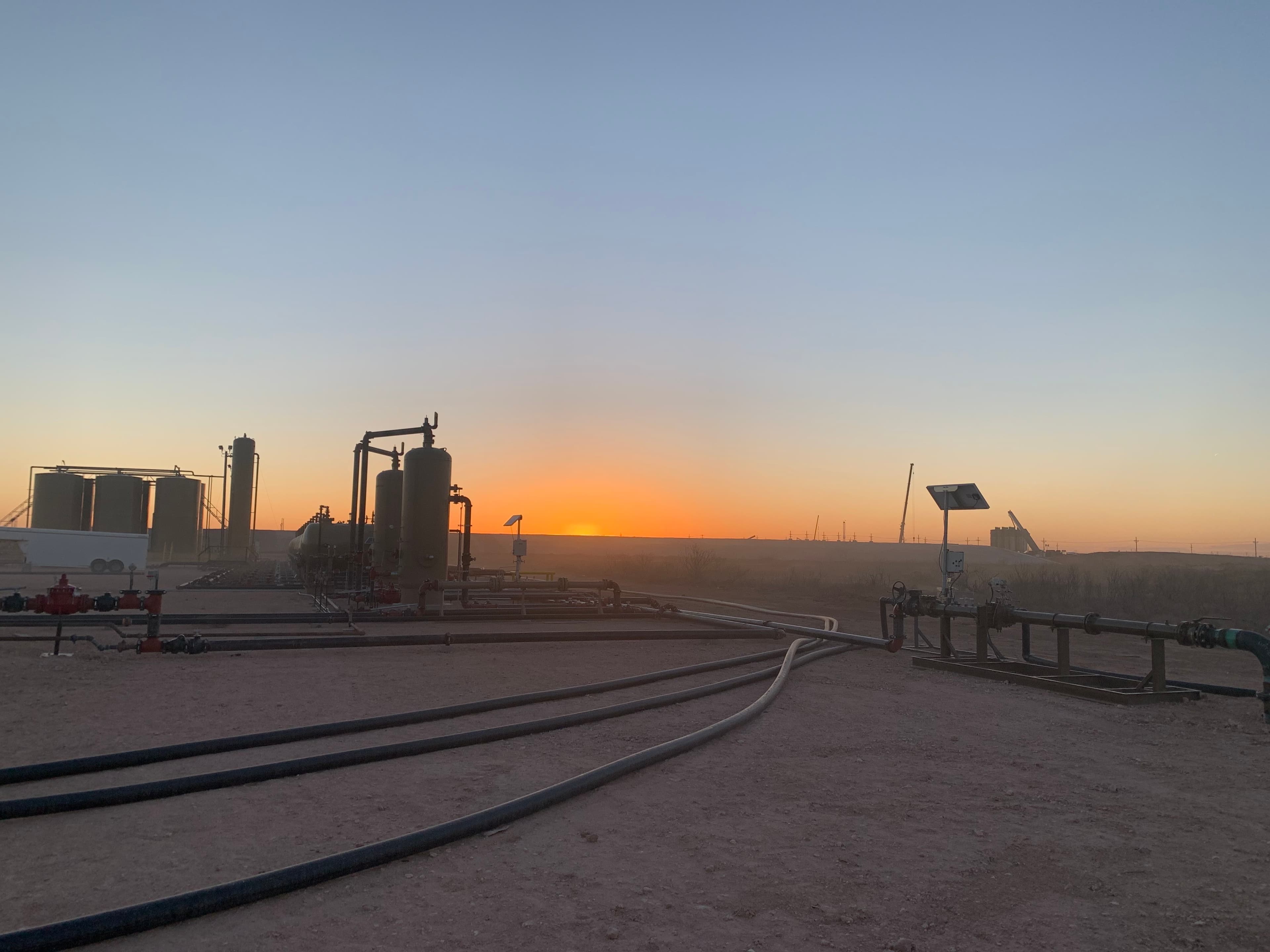
Time to power now decides whether a data center project happens at all. Energy service providers enable the data center boom by delivering on-site natural gas generation, mechanical construction, custom skid fabrication, and 24/7 operations and maintenance that bring facilities online in 12 to 18 months, while grid interconnection queues stretch 3 to 5 years.
That gap between what the grid can deliver and what developers need is reshaping how data centers get built. And it is pulling oil and gas field services companies into the center of the conversation.
Why does the time it takes to get electricity to a site matter so much in data center development today?
Time to power decides whether a data center project is viable, because AI and cloud demand is outpacing utility transmission expansion. Interconnection queues run 3 to 5 years in many regions while operators want power inside 12 to 18 months. Every month of delayed energization is lost revenue and a missed commitment.
The scale of the demand explains the pressure. Goldman Sachs projected US data center power demand would roughly double by 2027 (Goldman Sachs). Gartner forecast data center electricity consumption would grow 26 percent in 2026 (Gartner). The IEA finds AI is the primary driver of that new load (IEA).
Grid queues run years while developers need power in months
Utility transmission expansion moves on a planning horizon measured in years. Permitting, right-of-way, and substation work do not compress to match a 12-month build schedule. So a developer who waits in the queue watches competitors energize first.
On-site natural gas generation as the bridge
On-site generation, natural gas turbines, reciprocating engines, and fuel cells, has become the practical response rather than a compromise. It puts the power source next to the load and takes the transmission backlog off the critical path. But that shift creates demand for service providers who understand both construction and long-term operations, because on-site power is only as good as the infrastructure feeding and maintaining it.
That is why developers now evaluate infrastructure partners as early as site selection. A company that operates more than 2,000 wells, hundreds of compressors, and pipeline networks under management, with 24/7 emergency response, has direct exposure to the systems data centers now depend on.
Why Does Gas Infrastructure Availability Determine Where Data Centers Get Built?
Gas infrastructure availability determines data center siting because on-site generation requires reliable fuel at volume, pipeline capacity to deliver it, and compression to hold pressure. No gas, no power. The question of where a facility can be built is increasingly a midstream question.
Fuel supply, pipeline capacity, and compression at volume
Building new pipeline infrastructure can add 12 to 24 months to a project. That timeline often exceeds the entire schedule for the data center itself. Regions with existing midstream networks eliminate that delay and move straight to interconnecting with capacity already in the ground.
Interstate pipelines and their expansions fall under FERC jurisdiction (FERC), and midstream safety is regulated by PHMSA (PHMSA). Developers factor that regulatory path into every siting decision.
The Appalachian Basin timeline advantage
The Appalachian Basin sits on Marcellus and Utica production with established pipeline networks, making it attractive for power-intensive facilities. The gas is local. The compression and gathering systems already exist.
Site viability comes down to two things: is there capacity nearby, and who operates it. A provider with an operational footprint spanning the Appalachian Basin from New York to Tennessee, running compressor operations and pipeline and pigging services across seven regional locations, answers both. For context on the region, see the Marcellus Shale Coalition and EIA production data (EIA).
Appalachian Basin midstream services
What Mechanical Construction Do Data Centers Actually Require?
Data center energy infrastructure requires gas metering and pressure regulation, fuel supply integration, custom equipment skids, and cooling systems tied to on-site generation. These demand energy construction expertise, not commercial building experience. A general contractor can pour the pad. Tying in the gas and building the skids is a different trade.
Metering, regulation, fuel handling, and custom skids
The mechanical scope sits where commercial construction ends. Pressure vessels and process piping follow ASME B31 codes (ASME), and welding meets AWS standards (AWS). Splitting this scope across multiple vendors creates coordination gaps and schedule risk. Delays often come from mechanical completion and commissioning, not just utility interconnection.
Why fabrication capacity becomes a regional bottleneck
Custom component lead times become bottlenecks when 10 to 20 data centers compete for the same metering skids and regulation equipment in one region. A backlogged third-party shop can hold an entire project hostage.
In-region fabrication changes that math. ShalePro runs an integrated model: mechanical construction, pipe fabrication at the West Alexander shop and yard plus Clarksburg and Thompson facilities, helical pile installation, and civil construction performed in-house by one accountable team. Fabricating custom components in-region rather than depending on backlogged shops keeps the schedule in the owner's control.
pipe fabrication and mechanical construction
Why Do Operations and Maintenance Capabilities Matter From Day One?
O&M capabilities matter from day one because data centers commit to uptime SLAs that leave no room for unplanned mechanical failures. The clock on reliability starts the day a facility energizes. On-site generation, compression, fuel handling, and cooling require continuous operations and planned maintenance that general contractors do not provide.
A tripped compressor at 2 a.m. is a blip or an outage depending on who is on call.
Uptime commitments leave no room for unplanned failures
Reliability tiers from the Uptime Institute (Uptime Institute) translate into hard financial penalties when power or cooling drops. The mechanical systems feeding those tiers have to be maintained like the midstream assets they resemble.
24/7 response when a compressor trips at 2 a.m.
24/7 emergency response and regional crew positioning decide whether a tripped compressor is a blip or an outage. The same real-time performance discipline that keeps midstream facilities running maps directly onto data center mechanical systems that cannot go down.
ShalePro's O&M services cover well tending, compressor operations, pipeline operations, and mechanical technicians, backed by 24/7 emergency response with crews positioned across the field. Operating more than 2,000 wells and hundreds of compressors means managing the same uptime pressure data centers face. Matt Lowther, VP, Midstream and O&M Services, oversees this work.
How Do Safety Programs and Regional Presence Reduce Project Risk?
Safety programs and regional presence reduce project risk because construction incidents delay energization and create liability for owners who cannot absorb schedule slippage. Leading-indicator safety programs prevent incidents rather than reacting to them. OSHA sets the baseline for oil and gas construction hazards (OSHA).
Leading-indicator safety keeps schedules intact
A dedicated field safety team running observations, incident management, and compliance means accountability does not fall on project managers to self-report. ShalePro's leading-indicator safety program logs more than 500 field safety observations every quarter, led by Director of Safety Cooper Ferko, with daily tailgate meetings and thorough Job Safety Analyses. Certifications include ISNetworld, Veriforce Preferred, DOT Compliant, and OSHA Compliant.
Decades of regional relationships cut permitting surprises
Developers entering a new region face permitting unknowns, utility relationship gaps, and environmental compliance learning curves. Established regional operators navigate these faster. Environmental compliance for gas operations runs through the EPA (EPA) and, in the region, the Pennsylvania DEP (PA DEP).
Permitting, utility coordination, and labor availability become known variables when a partner has worked the region for decades. ShalePro's operating heritage dates to 1994, with memberships in the Appalachian Basin GPA Midstream Association and the Virginia Oil and Gas Association across seven regional locations.
Why Does Integrated Service Delivery Beat a Multi-Vendor Approach?
Integrated service delivery beats a multi-vendor approach because it removes handoff gaps, schedule conflicts, and accountability confusion that surface when systems fail to commission on time or underperform. Data center owners need certainty, not explanations about which vendor owns a missed deadline.
| Factor | Multi-vendor model | Integrated provider |
|---|---|---|
| Accountability | Split across contracts | One team, one phone number |
| Schedule risk | Handoff gaps between trades | Controlled scope end to end |
| Fabrication | Depends on third-party backlog | In-region shop capacity |
| Operations | Separate O&M contract later | Continuous from day one |
Integrated providers control the full scope from site preparation through decades of operations, which compresses timelines and removes coordination risk. The value is one accountable team from the first grade stake to the thousandth maintenance visit.
ShalePro Energy Services is an oil and gas field services company serving the Appalachian Basin from Houston, Pennsylvania, specializing in mechanical construction, pipe fabrication, helical pile installation, and midstream operations and maintenance. Its model delivers in-house mechanical construction, fabrication, helical piles, civil construction, and long-term O&M through one team accountable from site preparation through long-term maintenance.
As Sam of Expand Energy put it: "ShalePro has been a strong partner for our operations, consistently executing complex facility construction projects with a strong focus on quality, safety, and schedule."
data center energy infrastructure services
Frequently Asked Questions
Which fuel cell providers offer full-service maintenance contracts for multi-megawatt data center installations and what are the terms?
Fuel cell original equipment makers and specialized energy service firms offer maintenance contracts covering monitoring, planned service, and parts, often tied to uptime guarantees. Terms vary by output and runtime. ShalePro does not manufacture fuel cells but provides the mechanical construction and 24/7 operations and maintenance that keeps on-site generation running.
How long does it take to build a natural gas powered data center compared to a grid connected one?
On-site natural gas generation can bring a data center online in roughly 12 to 18 months where fuel supply and pipeline capacity already exist. Grid-connected projects can wait 3 to 5 years in interconnection queues. That is why developers favor gas generation in gas-rich regions where the critical path to power is shortest.
Why is the Appalachian Basin becoming attractive for data center development?
The Appalachian Basin sits on Marcellus and Utica gas production with established pipeline and compression infrastructure. That existing midstream network lets developers tap on-site generation without waiting years for new pipeline builds. The result is a shorter critical path to reliable power in a region built around natural gas.
Can one contractor handle both construction and long-term operations for a data center?
Yes. Integrated energy service providers deliver site preparation, mechanical construction, fabrication, and ongoing operations and maintenance through one accountable team. This removes handoff gaps between builders and operators, a common cause of commissioning delays and uptime failures. Owners work with a single point of accountability across the full project life.
What causes delays in energizing a new data center besides utility interconnection?
Mechanical completion and commissioning often drive delays as much as interconnection. Custom skid fabrication backlogs, gas metering and regulation tie-ins, fuel system integration, and safety incidents can all push energization past schedule. Those risks multiply when mechanical scope is split across several vendors with no single owner.
Ready to Shorten Your Time to Power?
Time to power is the decision that makes or breaks a data center build, and the infrastructure behind on-site generation is where schedules are won or lost. Talk with a team that operates energy infrastructure every day across the Appalachian Basin.
Go with the Pro. Contact ShalePro Energy Services.
Sources
Gartner Says Data Center Electricity Consumption to Grow 26% in 2026
US Data Center Power Demand Projected to Double by 2027. Goldman Sachs
EIA projects record US data center power use amid AI and crypto boom. DCD