
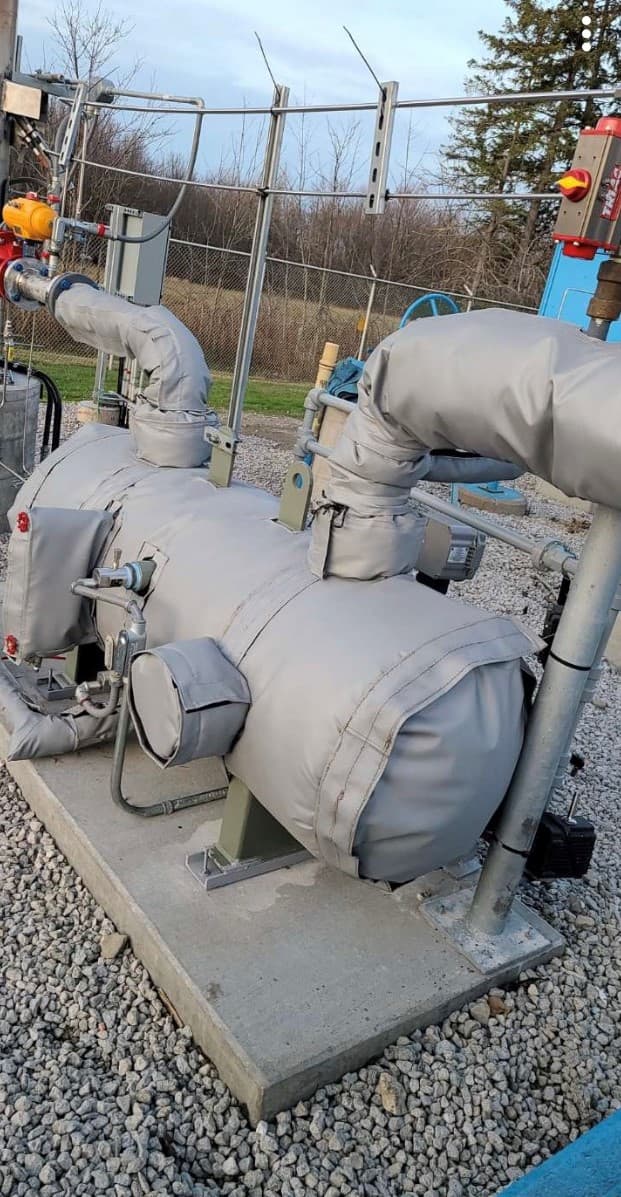
Mechanical insulation is the material system wrapped around process piping, vessels, and equipment to control heat flow, prevent condensation, and protect people from hot surfaces. In the field it covers compressor exhaust, process piping, and glycol units. Done right, it saves energy, stops corrosion, and keeps crews from getting burned on contact.
That last point matters more in midstream than most people outside the field realize. A compressor discharge line can run hot enough to cause a serious burn on contact. Insulation is the barrier between that surface and a worker's arm.
This guide covers what industrial insulation does, where it matters on a midstream site, how to choose material, and why the quality of the install usually outweighs the spec on the box.
What Is Mechanical Insulation?
Mechanical insulation is a layered system: a core material that resists heat transfer, a vapor barrier on cold systems, and an outer jacket that sheds water and takes abuse. It goes on piping, vessels, and rotating equipment that run hotter or colder than ambient.
The three jobs insulation does
Insulation does three jobs on a midstream site. First, energy efficiency: it cuts heat loss from hot systems and heat gain on cold ones, which keeps process temperatures stable and lowers fuel and compression costs. Second, corrosion prevention, mostly on cold service where condensation would otherwise form on bare steel. Third, personnel protection, keeping hot surfaces below burn temperature where crews work.
Those jobs often overlap on a single pipe run. A hot discharge line retains heat and protects personnel at the same time.
Field insulation versus building HVAC
This is not ductwork. Field insulation wraps compressor exhaust manifolds, glycol dehydration reboilers, and process piping carrying hot fluids, all of it on live equipment that runs around the clock.
ShalePro operates hundreds of compressors and more than 2,000 wells across the Appalachian Basin, so insulation here means hardware the audience runs every day. The operating context is different, and so is the install.
Where Does Industrial Insulation Matter in Midstream Operations?
Industrial insulation matters most on hot service lines, cold service with condensation risk, and any valve or flange crews open during maintenance. Each case drives a different material and detailing choice.
Hot service: exhaust manifolds, discharge piping, reboilers
Hot service is the obvious one. Compressor exhaust manifolds and discharge piping can run at extremely high temperatures, hot enough to burn on contact and a clear personnel safety liability. Glycol dehydration unit reboilers and process piping carrying hot fluids fall in the same bucket.
Here insulation does double duty: it keeps heat in the process and keeps the surface temperature survivable for a worker who brushes against it.
Cold service and condensation control
Cold service is trickier because the enemy is moisture. Piping below ambient temperature pulls condensation out of the air, and a humid Appalachian summer drives that hard. If the vapor barrier fails, the insulation soaks through and water sits against the steel, which starts corrosion under insulation.
Valves and flanges that need access
Valves, flanges, and equipment that crews open during maintenance get removable blankets instead of fixed insulation. Hard insulation gets destroyed every time a crew breaks a flange, so removable covers let the system come apart and go back together without wasting material.
Freeze risk in a Pennsylvania winter adds another layer of need. Heat retention on water and condensate lines keeps them from freezing and cracking.
How Do You Choose the Right Insulation Material?
Material choice comes down to three variables: operating temperature, weather and environmental exposure, and how often crews need access. Match those correctly and the system lasts. Guess, and it fails early.
Matching material to operating temperature
There is no single best material, only trade-offs. Fiberglass with aluminum or PVC jacketing handles most pipe runs. Mineral wool takes higher temperatures where fiberglass would break down. Closed-cell foam suits cold service because it resists moisture and controls condensation.
| Material | Best use | Strength |
|---|---|---|
| Fiberglass | General hot pipe runs | Cost and availability |
| Mineral wool | High-temperature service | Heat resistance |
| Closed-cell foam | Cold service | Moisture and condensation control |
| Removable blankets | Valves and flanges | Repeated access |
Jacketing and vapor barriers
Jacketing is the outer shell. It sheds water and takes physical abuse from traffic, tools, and weather. The vapor barrier is a separate function, and it is what keeps moisture out of cold systems. On cold service, a continuous vapor barrier is the difference between a dry system and a corroding one.
Access and maintenance trade-offs
A pipe that never gets opened can take permanent insulation. A flange that crews break twice a year should not. Insulation standards and material specs are published by bodies like ASME and industry references such as the Thermal Insulation Handbook for the Oil, Gas, and Petrochemical Industries, which specifiers use to size and select systems. International practice is set out in standards like ISO 12736 for thermal insulation systems.
Why Installation Quality Matters More Than the Material
A good material installed badly fails fast. Poorly fitted insulation, gaps at joints, missing vapor barriers, and damaged jacketing all drive early failure regardless of what the spec sheet promised.
What goes wrong in the field
The failures are predictable. A joint left unsealed lets water track in. A vapor barrier that stops short on cold service invites condensation behind it. Jacketing that sags or crushes under its own weight loses its weather seal. This is a material problem? No. It is an install problem.
Proper field practice means tight joint sealing, continuous vapor barriers on cold service, weather-shedding jacketing, and proper support so the system does not sag or crush.
The cheapest insulation installed correctly outlasts the best insulation installed wrong.
Why system knowledge beats product knowledge
The person who knows where a flange needs frequent access insulates it differently than someone treating pipe as pipe. That is the case for crews who understand the mechanical system.
At ShalePro, the same crews build, fabricate, and operate these systems, so they install insulation with the full system in view. They know which lines come apart at the next turnaround and detail them accordingly.
Insulation as Part of Integrated Mechanical Services
ShalePro performs industrial insulation in-house alongside mechanical construction, pipe fabrication, and operations and maintenance, so a client works with one accountable team from site preparation through long-term maintenance.
One crew, one accountability chain
The practical advantage is simple. The crew installing pipe also insulates it. The team maintaining compressors also repairs insulation during turnarounds. Quality gaps between trades close, and no one points fingers when something fails.
"ShalePro has been a strong partner for our operations, consistently executing complex facility construction projects with a strong focus on quality, safety, and schedule.". Sam, Expand Energy
ShalePro Energy Services is an energy and industrial services company headquartered near Pittsburgh in Houston, Pennsylvania, serving the Appalachian Basin, specializing in mechanical construction, pipe fabrication, helical pile installation, and midstream operations and maintenance.
From fabrication shop to field to maintenance
Pipe fabrication and insulation can happen together at the West Alexander shop, producing pre-assembled modules. That cuts field installation time and reduces exposure to weather and site access constraints during construction.
The company runs roughly 300 employees across seven locations and takes work in New York, Pennsylvania, Ohio, West Virginia, Virginia, Kentucky, and Tennessee. See industrial insulation services and pipe fabrication capabilities for detail.
How Is Insulation Work Kept Safe on an Active Site?
Insulation work on live equipment is governed by Daily Tailgate safety meetings, a thorough Job Safety Analysis, hot work permits, and lockout/tagout procedures. Crews work around operating compressors and pipelines, so the protocols come before the first wrap goes on.
Daily protocols on live equipment
Every shift starts with a tailgate meeting and a job safety analysis specific to that task. Hot work near fuel systems requires a permit. Lines that must be isolated get locked and tagged out before anyone touches them. These follow federal standards from OSHA and pipeline safety rules under PHMSA.
A safety team that runs the site
ShalePro's leading-indicator safety program is backed by a dedicated field safety and training team that logs more than 500 field safety observations every quarter. That team handles observations, incident management, and compliance.
The company holds ISNetworld, Veriforce Preferred, DOT Compliant, and OSHA Compliant credentials. And 24/7 emergency response means crews can address a failure like torn jacketing or a soaked vapor barrier before it threatens operating equipment. See compressor operations and maintenance for related field services.
Frequently Asked Questions
How does damaged insulation shorten the life of midstream equipment?
Cracked or missing jacketing lets water into the insulation, which soaks the material and traps moisture against the pipe. That drives corrosion under insulation. A small cover failure can lead to expensive pipe replacement if it goes uninspected, turning a minor repair into a major one.
When should insulation be inspected during a maintenance turnaround?
Inspect insulation every routine turnaround, checking jacketing seams, vapor barriers, and areas near valves opened during service. Catching gaps, impact damage, and water intrusion early prevents corrosion and keeps replacement work small, rather than letting a system fail between maintenance cycles and forcing emergency work.
What credentials should an industrial insulation contractor hold?
Expect ISNetworld certification, Veriforce preferred status, and DOT and OSHA compliance. For midstream work, also look for crews with field experience on compressors and pipelines, plus documented safety protocols like Job Safety Analysis and hot work permitting on active sites. Integrated mechanical capability is a strong plus.
Can insulation be installed on pipe in a fabrication shop before it ships?
Yes. Pipe fabrication and insulation can happen together in a shop, producing pre-assembled modules. ShalePro does this at its West Alexander shop, which cuts field installation time and reduces exposure to weather and site access constraints during construction, delivering more predictable schedules to the field.
Does ShalePro provide emergency insulation repair?
ShalePro runs 24/7 emergency response with crews positioned across the field. For failures like torn jacketing or a compromised vapor barrier on operating equipment, that coverage lets crews address the problem before moisture or heat loss affects production or starts corrosion under insulation.
Conclusion
Industrial insulation is quiet infrastructure. It rarely gets noticed until a line freezes, a surface burns someone, or corrosion under a failed jacket forces a pipe replacement. The material matters, but the install and the crew behind it matter more.
The strongest position is integrated: the same team that fabricates, builds, and maintains the system also insulates it, with the full mechanical picture in view. That closes the quality gaps that open when trades hand off to each other.
Ready to talk about insulation on your compressors, pipelines, or process equipment? Contact ShalePro Energy Services.
Sources
ISO 12736-1:2023. Wet thermal insulation systems for pipelines and subsea equipment
Thermal Insulation Handbook for the Oil, Gas, and Petrochemical Industries
PHMSA. Pipeline and Hazardous Materials Safety Administration