
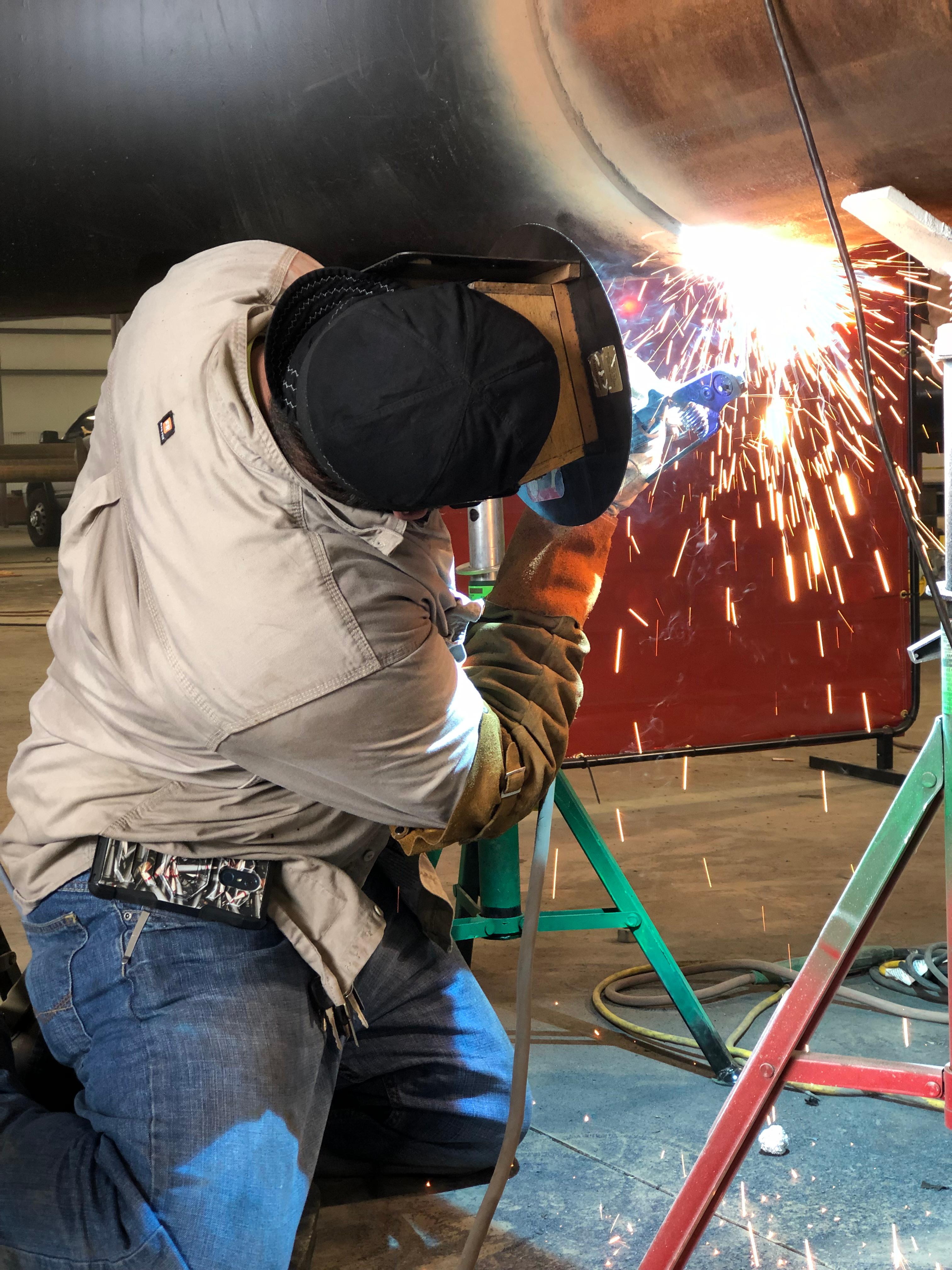
Mechanical construction in oil and gas is the field installation of piping systems, process equipment, compressor packages, and interconnects at production facilities, gathering systems, and pipeline infrastructure. It is the trade that turns a prepared site and a set of fabricated spools into a running facility. The scope runs from setting major equipment through final tie-ins and commissioning.
This guide walks through what that scope covers in midstream work, how integrated crews lower project risk, and what to look for when you hire a mechanical construction contractor in the Appalachian Basin.
What Does Mechanical Construction Mean in Midstream Infrastructure?
Mechanical construction services are the installation and assembly of mechanical systems in the field: process piping, pumps, vessels, heat exchangers, compressor packages, and the interconnects that tie them together. On a midstream project it is the phase that follows site work and fabrication and feeds directly into startup.
Core scope: piping, process equipment, and tie-ins
The core of a mechanical construction scope is process piping and the equipment it connects. Crews set compressor packages and vessels, run and support the piping between them, and complete tie-ins to existing systems. Pressure piping on these jobs is governed by ASME B31 process piping codes, and welds follow API and AWS requirements (ESAB overview of API, ASME and AWS standards).
Mechanical construction contractors bid and manage this work as a distinct trade, separate from shop fabrication or dirt work.
How mechanical construction differs from civil and fabrication work
Fabrication is shop work. Piping spools and modules get assembled in a controlled building, then inspected before they ship. Civil work is the site itself: clearing, grading, earthwork, and foundations. Mechanical construction is the field assembly that sits between them, installing fabricated components onto completed foundations and joining everything into a working system.
The lines matter because each phase carries its own codes, inspection points, and skilled trades. A clean handoff between them is where schedules are won or lost.
Typical scope at compressor stations and gathering systems
At a compressor station or facility expansion, a mechanical construction scope usually covers setting the compressor and auxiliary equipment, running suction and discharge piping, installing valves and instrumentation supports, completing tie-ins to the gathering system, and supporting commissioning. Pipeline and pigging services sit alongside this work but do a different job. They clean and inspect the line rather than build the facility.
ShalePro lists mechanical construction as a distinct service line alongside operations and maintenance, fabrication services, civil construction, and pipeline and pigging services, all performed in-house. The company manages more than 2,000 wells and operates hundreds of compressors and pipeline networks across the Appalachian Basin. That operational context is something most mechanical construction contractors simply do not have.
Why Do Integrated Mechanical and Civil Capabilities Reduce Project Risk?
Integrated capability lowers risk because it removes the interfaces where projects stall. One team owns everything from dirt to commissioning, which means fewer handoff delays and one safety standard across the whole job.
The coordination cost of multiple subcontractors
Every contractor boundary is a point of friction. The foundation crew leaves, the mechanical construction crew arrives, and the gap between them is where mismatched tolerances, access disputes, and finger-pointing live. Each handoff adds mobilization cost, documentation gaps, and days where nobody is making progress.
One accountable team for safety and quality removes the finger-pointing between trades.
Single-source accountability from site prep through commissioning
Single-source delivery is risk mitigation. When one team owns site preparation, foundations, mechanical construction installation, and commissioning, there is one safety program, one quality standard, and one point of accountability if something goes wrong. Nobody gets to blame the crew that already demobilized.
Schedule compression when one team owns the handoffs
One crew coordinating from helical pile foundations through equipment setting compresses the schedule by killing idle time between phases. In unstable Appalachian terrain, the interface between helical pile foundations and mechanical construction is especially sensitive. Equipment loads and anchor placement have to agree before piping ever gets hung.
ShalePro performs civil construction, helical piles, and mechanical construction in-house, so a client works with one accountable team from site preparation through long-term maintenance. Mechanical construction projects in the Marcellus and Utica shale formations often face schedule pressure from regulatory deadlines and seasonal weather windows. Integrated crews cut weeks off the critical path.
The Fabrication Shop Advantage for Mechanical Construction Projects
A fabrication shop shortens mechanical construction timelines by moving work out of the field and into a controlled environment. Spools and modules get built and inspected under a roof, then shipped ready to install.
Pre-assembling piping spools and modules in a controlled environment
Shop pre-assembly means welding, fit-up, and inspection all happen before anything reaches the site. Quality control is tighter when a fitter works at a bench instead of in a trench. Nondestructive testing happens in one place too, rather than scattered across a muddy right-of-way (ASNT). Radiographic and ultrasonic inspection cycles run faster when the piece never leaves the building.
Fewer field welding hours and fewer weather delays
Every weld moved into the shop is a field weld that no longer depends on weather, site access, or daylight. Cut your field welding exposure and you cut delays, and you improve the odds of passing inspection on the first attempt. That keeps the commissioning date intact. On a typical compressor station build, shop fabrication can eliminate 60-70% of field welding hours.
Certified welders and fabricators versus general field labor
Code work needs certified welders and fabricators. API and AWS welder qualification requirements are binding on pressure piping, and inspectors will reject work that cannot show the paperwork behind it. Certified welders and fabricators are among ShalePro's listed career roles.
Proximity matters too. ShalePro operates a fabrication shop and yard in West Alexander, PA, plus shops in Clarksburg, WV and Thompson, PA. A shop close to the job reduces transport time and schedule risk, which hits mechanical construction managers right where it hurts. See the fabrication services page for shop detail.
How Leading-Indicator Safety Programs Work on Mechanical Construction Projects
A leading-indicator safety program identifies hazards before an incident occurs, rather than counting injuries after the fact. On mechanical construction projects, that means structured daily practices and a dedicated safety team in the field.
Daily Tailgate meetings and Job Safety Analysis as standard practice
Standard field practice starts each day with a Daily Tailgate meeting and a thorough Job Safety Analysis on each job. Crews walk the specific hazards of that day's task, confirm controls, and document them before tools come out. OSHA's oil and gas extraction guidance treats this kind of hazard analysis as foundational (OSHA Oil & Gas).
Mechanical construction work involves confined space entry, hot work permits, crane operations, and energized tie-ins. Each carries specific control requirements. Daily JSAs surface them before the work starts.
Field observations as leading indicators
Field observations are the leading indicator. ShalePro logs more than 500 field safety observations every quarter, catching unsafe conditions and behaviors before they turn into incidents. Lagging metrics tell you what already happened. Observations tell you what is about to.
Compliance infrastructure operators require
A dedicated safety and training team runs observations, incident management, and compliance rather than leaving it to the site supervisor or the client. Midstream operators treat a specific set of credentials as table stakes, and they should already be in place rather than assembled project by project.
ISNetworld Certified Veriforce Preferred DOT Compliant and OSHA Compliant Veriforce SafeLandUSA Trained Crews
See the safety program page for how these fit together. Mechanical construction contractors without these credentials are unlikely to pass operator prequalification.
Mechanical Construction in the Appalachian Basin
Mechanical construction in the Appalachian Basin is shaped by steep, wooded terrain and constrained site access across a multi-state regulatory map. Crews stage and execute differently here than on flat, open ground.
Terrain and site access in Marcellus and Utica country
Marcellus and Utica pads sit on ridgetops and hillsides reached by narrow access roads. That reality drives how equipment gets delivered, where it stages, and how piping gets rigged into place. Crews who already understand these site conditions plan around them instead of discovering them on mobilization day.
A 10,000-horsepower compressor package arrives on a lowboy. The access road has a 12% grade and two switchbacks. That delivery does not happen by accident. It happens because the mechanical construction contractor walked the route before the bid.
A multi-state regulatory environment from New York to Tennessee
The basin spans several states, each with its own permitting and environmental framework, from the Pennsylvania DEP (PA DEP) to federal pipeline safety rules under PHMSA (PHMSA). Interstate gas infrastructure also falls under FERC jurisdiction (FERC). Local fluency shortens the permitting timeline. Mechanical construction contractors who lack basin experience often miss state-specific stormwater or air permit triggers until the inspector shows up.
The Pipeline and Hazardous Materials Safety Administration publishes incident data by state and operator. Appalachian operators show up in that data when mechanical construction goes wrong, which is why prequalification standards are high.
Why a regional shop network and positioned field crews matter
A distributed shop network and crews positioned across the field shorten response and reduce logistics risk. ShalePro is headquartered in Houston, Pennsylvania near Pittsburgh, with seven locations across Pennsylvania, West Virginia, Virginia, and Tennessee, and takes work from New York to Tennessee. Its memberships include the Appalachian Basin GPA Midstream Association (GPA Midstream) and the Virginia Oil and Gas Association.
Regional presence means a mechanical construction contractor can stage emergency response, fabricate and deliver spools faster, and pull certified welders from multiple shops when a job accelerates. That flexibility matters when a client needs a compressor online before winter.
How to Evaluate a Mechanical Construction Contractor
Evaluate a mechanical construction contractor on in-house capability, a documented safety program, shop proximity, geographic coverage, and real references. The table below sorts the signals that matter from the ones that do not.
| Qualification | Why it matters | What to ask for |
|---|---|---|
| In-house civil, mechanical construction, fabrication | Fewer handoffs, one accountable team | Which scopes are self-performed vs. subbed |
| Documented safety program | Leading indicators beat reactive counts | Observation cadence, JSA practice, certs |
| Fabrication shop proximity | Cuts transport and weather risk | Shop locations relative to the site |
| Operational background | Builds for maintenance access | Assets operated, O&M service line |
| Named references | Verifiable track record | Current basin clients |
In-house capability versus subcontractor network
Ask directly which scopes a mechanical construction contractor self-performs and which it subcontracts. In-house civil, mechanical construction, and fabrication capability means fewer interfaces and one safety standard across the whole job. Subcontracted work splits accountability and adds coordination overhead at every handoff.
Maintenance-ready installation and the construction-to-operations handoff
Contractors with operations backgrounds make better installation decisions because they know how design choices affect technician access and long-term reliability. Mechanical construction is one phase in a lifecycle that flows into long-term operations and maintenance, and it should be built that way. A contractor who does not operate assets tends to optimize for construction speed rather than maintenance access.
Compliance, references, and basin track record
ShalePro Energy Services is an oil and gas field services company serving the Appalachian Basin from Houston, Pennsylvania, specializing in mechanical construction, pipe fabrication, helical pile installation, and midstream operations and maintenance. The company manages more than 2,000 wells and operates hundreds of compressors with 24/7 emergency response.
As Sam of Expand Energy put it: "ShalePro has been a strong partner for our operations, consistently executing complex facility construction projects with a strong focus on quality, safety, and schedule." Brendan Burke, VP of Production at Seneca Resources Company, LLC, added that "ShalePro has been a trusted partner for over a decade."
References matter because they are verifiable. A mechanical construction contractor can claim basin experience. A named client confirming it is different.
Frequently Asked Questions
What is the difference between mechanical construction and fabrication?
Fabrication builds piping spools and modules in a controlled shop environment, where they can be inspected before transport. Mechanical construction is the field work of setting equipment, installing those components, completing tie-ins, and commissioning. Many providers offer both so shop and field work stay coordinated under one team.
Does ShalePro subcontract its mechanical construction work?
ShalePro performs mechanical construction, civil construction, fabrication, helical piles, and long-term maintenance in-house. A client works with one accountable team from site preparation through commissioning and ongoing operations, which removes the handoff gaps that come with managing multiple subcontractors across a single project.
What certifications should a midstream mechanical construction contractor hold?
Look for ISNetworld certification, Veriforce preferred status, DOT and OSHA compliance, and SafeLandUSA trained crews. These should already be in place rather than assembled for a single project. ShalePro holds all of these and belongs to the Appalachian Basin GPA Midstream Association, signaling basin fluency and regulatory familiarity across the region.
How does a fabrication shop near the job site shorten a mechanical construction project schedule?
Shop pre-assembly moves welding and module work out of the field into a controlled space, where quality checks happen before delivery. That cuts field welding hours and weather delays. A shop close to the site also reduces transportation time and schedule risk at final tie-in and commissioning, especially when late design changes require rapid spool rework.
Why does operational experience matter for a mechanical construction contractor?
A contractor that also operates infrastructure understands how installation choices affect technician access and maintenance intervals. ShalePro manages more than 2,000 wells and hundreds of compressors, so its construction crews build with long-term reliability and operations readiness in mind. That experience shows up in valve placement, instrument support design, and access platform decisions.
How long does a typical mechanical construction project take in the Appalachian Basin?
A small compressor station or facility tie-in can run 4-8 weeks from mobilization to commissioning. A greenfield gathering station with multiple compressor packages, separators, and metering runs 12-20 weeks depending on site conditions and scope complexity. Integrated contractors compress these timelines by overlapping civil, mechanical construction, and commissioning phases under one schedule.
What does mechanical construction cost per horsepower or per facility?
Mechanical construction costs vary widely based on equipment complexity, site access, and scope. A rough benchmark for Appalachian compressor stations runs $150-$250 per installed horsepower for mechanical construction labor and materials, excluding equipment procurement. Tight sites with limited laydown area or challenging foundation conditions push the upper end of that range. Fixed-price bids require a defined scope and site survey.
Next Steps for Mechanical Construction Projects
Mechanical construction goes smoother when one team owns the site, the shop, and the handoff into operations. ShalePro brings in-house civil, fabrication, and mechanical construction crews with Appalachian Basin experience and a leading-indicator safety program to every job.
Talk to the team at ShalePro contact page to scope your next mechanical construction project.
Sources
Oil and Gas Pipeline Welding Standards: A Guide to API, ISO, ASME and AWS Compliance