
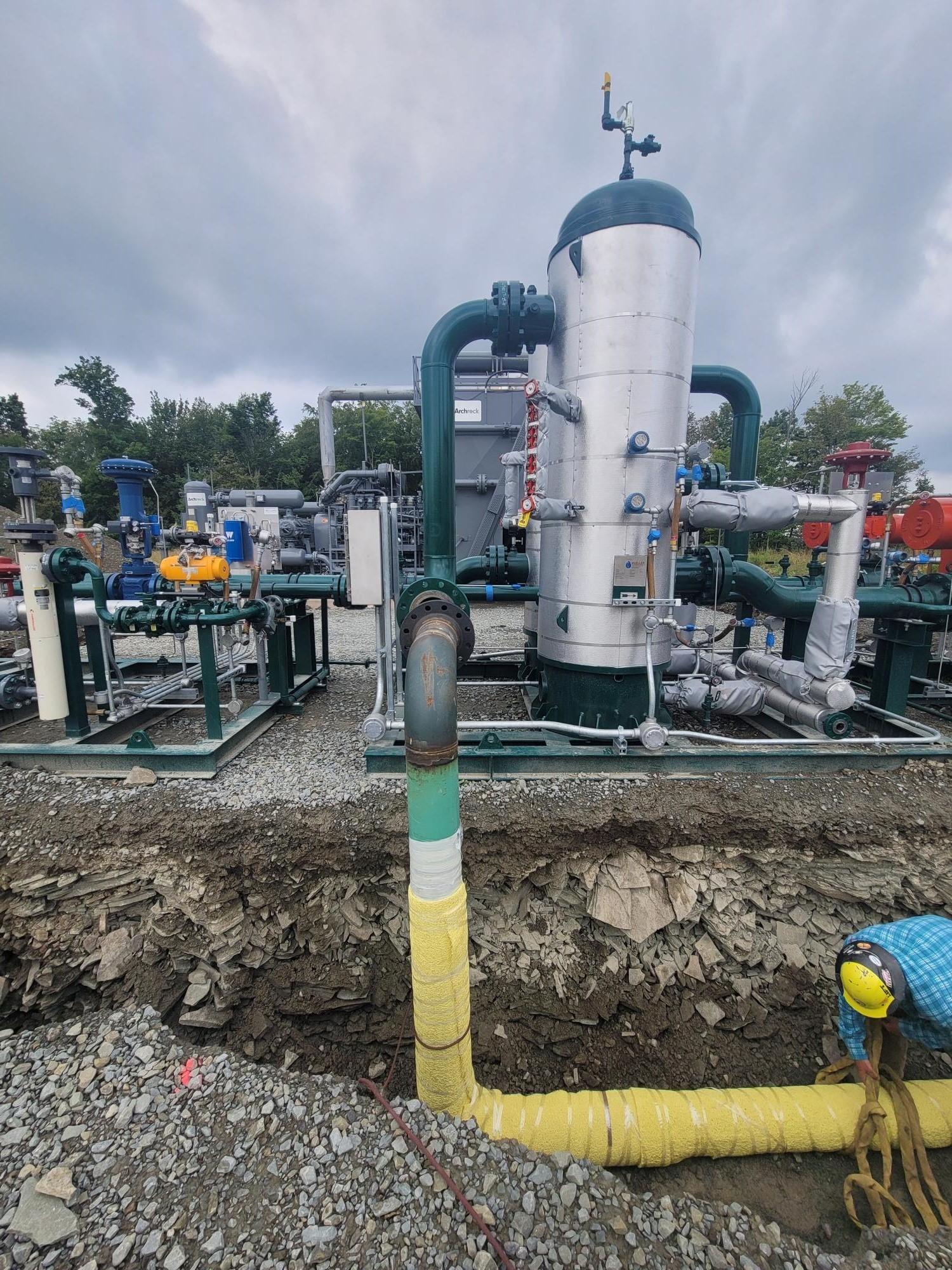
Midstream pipeline construction is the full build of gathering and lateral infrastructure, from right-of-way clearing and civil site prep through pipe welding, coating, hydrostatic testing, cathodic protection, and DOT Part 192 commissioning. In the Appalachian Basin, that work moves gas from the wellpad to compressor stations and processing, under a mix of federal pipeline safety rules and state environmental permits that set the schedule.
The basin complicates nearly every stage. Steep grades, karst geology, and seasonal mud windows reshape the civil math. Delivery model choices then decide how much coordination risk an operator carries. This guide walks the scope, the terrain, and the trade-offs field operators weigh before awarding a job.
What Midstream Pipeline Construction Actually Includes
Midstream pipeline construction covers the complete sequence that turns a right-of-way into an operating gathering system: clearing and grading, access roads, foundations, pipe welding, inspection, coating, hydrostatic testing, cathodic protection, and final regulatory commissioning. It sits between upstream drilling and downstream processing, moving product from the wellhead toward market.
Gathering Systems vs. Transmission Pipelines
Appalachian gathering systems typically run 6-inch to 16-inch diameter, intrastate, connecting wellpads to compressor stations over shorter routes. Interstate transmission lines run larger, often up to 36 inches, and fall under FERC jurisdiction with separate siting and tariff requirements.
That distinction matters. Gathering lines sit mostly under state and DOT pipeline safety rules, while interstate transmission adds a federal siting layer on top. The civil footprint, the permitting path, and the regulatory milestones all differ because of it.
The Full Scope From Clearing to Commissioning
The lifecycle runs in a defined order. Skip a step or compress one, and the risk pushes downstream, usually into the hydrotest or the first inspection.
- Right-of-way clearing and grading, plus access roads built to carry heavy equipment
- Foundations for compressor stations, meter buildings, and launcher or receiver skids
- Pipe stringing, bending, and field welding to AWS and API weld procedures
- Radiographic or ultrasonic inspection of every weld
- Coating and field joint coating to protect against corrosion
- Hydrostatic testing to prove pressure integrity
- Cathodic protection installation and verification
- Regulatory inspection, documentation handoff, and commissioning
The Regulatory Milestones That Set the Schedule
Federal rules under 49 CFR Part 192 set minimum safety standards for natural gas pipelines, administered by PHMSA. Part 192 governs materials, welding qualification, testing, and corrosion control, so its requirements shape the critical path rather than trailing behind it.
State permits add a second layer. Much of the civil and crossing work in the basin runs through the Pennsylvania DEP or its West Virginia equivalent. PHMSA has also clarified which midstream gathering facilities fall inside federal jurisdiction, a question that drives documentation scope (PHMSA midstream FAQ).
ShalePro performs civil construction, mechanical construction, fabrication, and pipeline operations in-house, so scope flows from site prep through commissioning under a single project manager and safety program.
Why Appalachian Basin Terrain Changes the Civil Equation
Appalachian terrain raises the civil cost and risk of midstream pipeline construction well above what flat-ground work in Texas or Oklahoma faces. Steep grades, voided subsurface rock, and short seasonal windows all compress schedule and complicate foundation design.
Steep Grades and Equipment Access
Steep slopes complicate grading, equipment staging, and erosion control. Sidehill cuts require engineered benches, and moving spoil on a grade is far harder than on a flat spread. Access roads often become their own construction project before pipe ever arrives.
Erosion and sediment control carries real regulatory weight too. Disturbed slopes shed sediment fast, and a stormwater violation can stop work cold until the site is stabilized.
Karst Geology and Seasonal Restrictions
Karst geology creates unpredictable subsurface voids. A conventional spread footing can sit over a solution cavity that only reveals itself under load, which makes foundations for compressor stations and meter buildings a genuine engineering risk.
Seasonal frost and mud restrictions compress the window further. Spring thaw turns haul roads to mush, and frozen ground limits trenching. Contractors who plan the sequence around weather hold schedule better than those who assume a full calendar.
Stream Crossings and Helical Pile Foundations
Stream crossings in the basin often fall under state permits, notably Pennsylvania Chapter 105 Water Obstruction and Encroachment approvals and West Virginia stormwater and erosion controls, rather than Army Corps review alone. Horizontal directional drilling is common for boring under waterways and roads without open-cutting the channel.
Where conventional footings fail, helical piles transfer load deeper into competent strata and install faster in variable soil. Guidance from the Deep Foundations Institute treats helical piles as a proven answer for difficult ground, yet most general pipeline contractors do not carry the capability in-house.
ShalePro operates seven locations across Pennsylvania, West Virginia, Virginia, and Tennessee, maintains helical pile installation as a dedicated service line, and runs civil crews familiar with local geology and permitting from New York through Tennessee.
How Do Midstream Operators Compare Project Delivery Models for Compressor Station Construction?
Operators compare turnkey single-source delivery against segmenting civil, mechanical, welding, and coating across separate subcontractors, weighing accountability, schedule, and risk at each option. The choice shapes who owns the critical path and who absorbs the cost when something slips.
Segmented Trades: Coordination Gaps and Diffused Accountability
Spreading trades across multiple general contractors creates handoff gaps. Each sequential transfer adds schedule, and each contract boundary becomes a place where accountability blurs. When a weld defect or a hydrotest failure surfaces late, the finger-pointing between the welding sub, the coating sub, and the civil contractor stalls the fix.
The Turnkey Model: One Contract, One Critical Path
The turnkey alternative puts one contract, one safety program, and one project manager over the entire build from site prep through commissioning. The critical path has a single owner. Problems get resolved inside one team instead of across contract lines.
| Factor | Segmented Trades | Turnkey Single-Source |
|---|---|---|
| Accountability | Diffused across subs | One contractor owns outcome |
| Schedule | Sequential handoffs add time | Compressed, coordinated internally |
| Change orders | Markup and friction at each boundary | Absorbed inside one team |
| Safety program | Varies by sub | One unified program |
| Fabrication lead time | Variable, project-dependent | In-house, flexible |
How In-House Fabrication Controls Schedule and Cost
Third-party fabrication of spools and skids can add substantial lead time, which may delay critical-path equipment and expose a project to steel pricing swings. Every design tweak then becomes a change order with markup attached.
In-house fabrication removes that lead-time exposure and lets a project absorb mid-build design adjustments without supplier markup. ShalePro's in-house civil, mechanical, fabrication, and operations teams eliminate multi-vendor coordination, and the fabrication shop and yard in West Alexander, PA builds spools, skids, and custom assemblies for delivery across the Central Region without third-party delays.
What Compliance and Safety Credentials Do Operators Actually Check?
Procurement teams verify ISNetworld certification, Veriforce credentials, DOT Part 192 compliance documentation, and OSHA training records before awarding a contract. A contractor without that documentation infrastructure gets screened out early, regardless of field skill.
ISNetworld and Veriforce as Procurement Gatekeepers
These platforms function as gatekeepers. Operators use them to confirm insurance, safety statistics, training records, and regulatory standing before a bid ever reaches a decision-maker. Weak documentation ends a contractor's chances before the work scope is even discussed.
Leading Indicators vs. Lagging TRIR Metrics
Total Recordable Incident Rate is a lagging metric. It reports what already went wrong and says nothing about whether a crew actively prevents the next incident. Leading indicators tell a fuller story: daily tailgate meetings, a Job Safety Analysis before each task, and field safety observations logged every quarter.
OSHA documents the hazards that make this discipline matter in oil and gas work. ShalePro is ISNetworld Certified, Veriforce Preferred, DOT Compliant, and OSHA Compliant, with crews trained through Veriforce SafeLandUSA, and its safety team logs more than 500 field safety observations every quarter.
Why Local Crew Presence Matters for Appalachian Projects
Local crew presence matters because Appalachian winters, mud season, and late-arriving permits create schedule volatility that rewards contractors who can mobilize in hours rather than days. A crew staged two states away cannot flex into a window that opens on short notice.
Weather and Permit-Driven Schedule Volatility
Permits frequently land late and compress the work window. Local crews flex into work as approvals arrive, keeping momentum instead of waiting on a mobilization. When weather clears for three dry days, the contractor already on the ground captures them.
Emergency Response During Construction and Commissioning
Construction and commissioning generate their own emergencies: equipment failures, hydrotest leaks, cathodic protection troubleshooting. A distant crew means travel time, per diem overhead, and hours lost before anyone reaches the site.
ShalePro maintains seven locations and field offices across Pennsylvania, West Virginia, Virginia, and Tennessee, including the Houston PA headquarters, West Alexander PA, Clarksburg WV, Thompson PA, Clintwood VA, St. Marys PA, and Kingsport TN, and operates 24/7 emergency response with crews positioned across the field.
The contractor already on the ground captures the dry window. The one mobilizing from Texas watches it close.
Pipeline Operations Continuity From Construction Into Long-Term O&M
The best construction contractor is often the company that will operate and maintain the asset long-term, because it builds to standards it will have to live with. ShalePro Energy Services is an oil and gas field services company serving the Appalachian Basin from Houston, Pennsylvania, specializing in mechanical construction, pipe fabrication, helical pile installation, and midstream operations and maintenance.
Building to Your Own Maintenance Standard
Construction shortcuts carry a lifecycle cost. Access roads built thin deteriorate under service traffic. Inadequate cathodic protection accelerates corrosion. Poor weld documentation haunts every future integrity inspection, since corrosion control standards from AMPP assume complete records exist.
A contractor who will tend the line later has every reason to build it right the first time.
Eliminating Commissioning Handoff Friction
Handoff friction appears when construction and O&M teams work for different companies. Documentation gaps, unclear as-built conditions, and finger-pointing over early failures all trace back to that seam. When the same crews commission and then tend the line, the seam disappears.
The mechanical and pipeline crews who build a gathering system stay available for pigging, inspection, and emergency response afterward. ShalePro provides Pipeline and Pigging Services, Compressor Operations, and long-term Operations and Maintenance, managing more than 2,000 wells and hundreds of compressors across the basin. Learn more about ShalePro midstream construction services and helical pile foundation installation.
Frequently Asked Questions
What diameter pipe is typical for midstream gathering systems in the Marcellus and Utica?
Appalachian midstream gathering systems typically run 6-inch to 16-inch diameter, connecting wellpads to compressor stations over shorter intrastate routes. This differs from interstate transmission lines, which reach 36 inches and fall under FERC jurisdiction with different regulatory and civil requirements that reshape both permitting and construction scope.
Which permits govern stream crossings for pipeline construction in Pennsylvania?
Stream crossings in Pennsylvania often require Chapter 105 Water Obstruction and Encroachment permits through the state Department of Environmental Protection, not just Army Corps approval. West Virginia work adds stormwater and erosion control permits. These state permits frequently sit on the project critical path and drive overall schedule.
Why are helical piles used instead of concrete footings for compressor stations?
Appalachian karst geology creates unpredictable subsurface voids where conventional spread footings can fail or require expensive remediation. Helical piles transfer load deeper into competent strata and install faster in variable soil, making them a practical foundation for compressor stations and meter buildings on difficult terrain.
How long do third-party fabrication lead times add to a pipeline project?
Third-party fabrication for spools and skids can add substantial lead time, which may delay critical-path equipment and expose a project to steel pricing swings. In-house fabrication removes that lead-time risk and allows mid-project design changes without change-order friction or supplier markup.
Is TRIR a reliable way to evaluate a pipeline contractor's safety?
TRIR is a lagging metric that reports incidents after they occur. Procurement teams increasingly look at leading indicators instead: daily tailgate meetings, Job Safety Analysis before each task, and quarterly field safety observations that show whether a safety culture actively prevents incidents before they happen.
Build and Operate With One Accountable Team
Midstream pipeline construction in the Appalachian Basin rewards contractors who understand the terrain, carry the credentials operators check, and stay to maintain what they build. Segmented trades scatter accountability. A single-source team holds the critical path.
See how ShalePro delivers civil, mechanical, fabrication, and pipeline work under one project manager at contact ShalePro Energy Services.
Sources
49 CFR Part 192. Transportation of Natural and Other Gas by Pipeline
PHMSA: Pipeline Safety Midstream Facilities Frequently Asked Questions
PHMSA. Pipeline and Hazardous Materials Safety Administration
FERC. Federal Energy Regulatory Commission
Pennsylvania Department of Environmental Protection