Supporting a new oil and gas operator in the Appalachian Basin means pairing them with a field services partner that covers the full asset lifecycle, from site preparation through decades of production, backed by a real basin presence and a working safety culture. The strongest support comes from four things: integrated service scope under one accountable team, safety measured through leading indicators, physical presence across the basin, and a contractor with staying power.
Picking on lowest bid or a single compliance badge alone exposes operators to safety risk, coordination gaps, and a higher total cost of ownership. This guide breaks down what to check before you sign.
How do you support new oil and gas operators in the Appalachian Basin?
You support new operators by matching them with a field services partner that owns the full asset lifecycle, not just one slice of it. Site preparation, facility construction, well tending, compressor operations, and pipeline integrity all connect. Split them across strangers and you create seams where mistakes hide.
New entrants and established operators expanding acreage have different starting points. But both need partners who understand Marcellus and Utica geology and can navigate compliance across state lines. The Appalachian Basin is one of the largest producing regions for U.S. dry natural gas, according to the U.S. Energy Information Administration, and production data from the agency confirms the region's outsized role in national supply.
Four things separate a real partner from a bid on paper:
- Service scope under one accountable team.
- Safety measured through leading indicators, not just certifications.
- Physical presence across the basin, near the work.
- A contractor with the ownership stability to outlast assets that often run 20 to 30 years.
Get those four right and most other problems shrink. Get them wrong and the operator inherits coordination headaches, slow emergency response, and the same crews getting retrained over and over.
What field services do new operators actually need?
New operators need construction and fabrication to build assets, then continuous operations and maintenance to run them for decades. Most underestimate the second part.
Construction and fabrication for new facilities
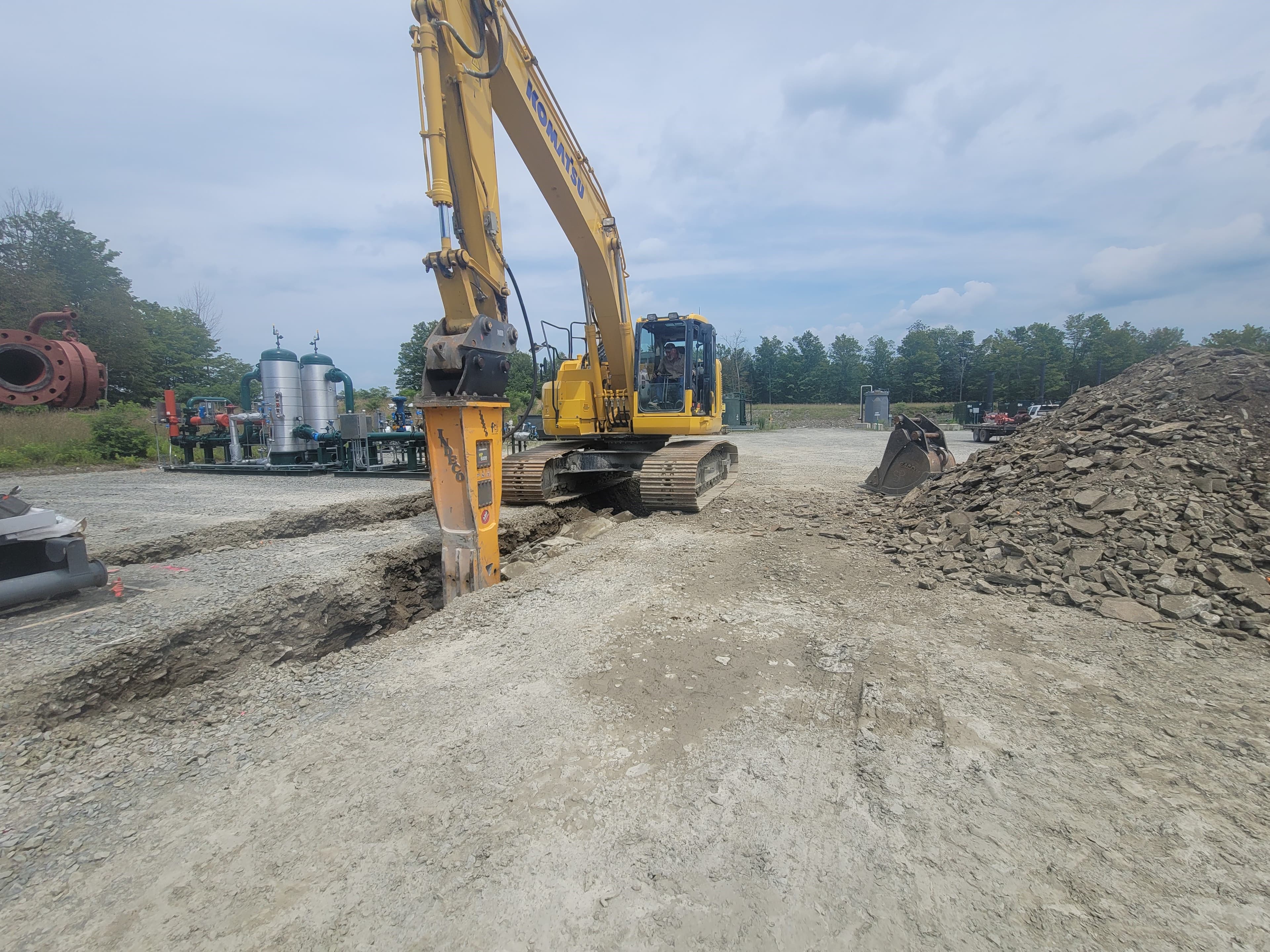
Building a facility requires site preparation, mechanical construction, pipe fabrication, and often deep foundation work like helical piles for compressor stations and equipment skids. Fabrication done in a controlled shop, then delivered to site, cuts field welding time and improves weld quality against ASME B31 process piping and AWS welding standards.
Foundation work matters more than new operators expect. Helical piles installed to Deep Foundations Institute practice give predictable capacity on the uneven, rocky terrain common across Appalachia.
Ongoing operations and maintenance
O&M is where the real intensity lives. Wells and compressors need daily tending. Pipeline systems need regular pigging and integrity work under PHMSA rules. Facilities need painting, insulation, and corrosion control to survive the elements and meet AMPP cathodic protection criteria.
A new operator that budgets for construction but treats O&M as an afterthought will feel it within the first year.
Why single-source support cuts coordination risk
Splitting construction, fabrication, and O&M across separate vendors looks cheaper on the bid sheet. But it adds coordination overhead, accountability gaps, and change-order cost every time two vendors point at each other.
A single accountable team from site prep through maintenance means an internal handoff instead of external knowledge transfer risk. As Sam at Expand Energy put it: "ShalePro has been a strong partner for our operations, consistently executing complex facility construction projects with a strong focus on quality, safety, and schedule."
How do you evaluate a contractor's safety program?
You evaluate a safety program by looking past the certifications to the leading indicators that reveal daily behavior. Certifications confirm minimums. Culture is what happens on site at 6 a.m. with no client watching.
Why certifications are table stakes, not proof
ISNetworld, Veriforce, DOT, and OSHA compliance confirm a contractor cleared the bar. They say nothing about how a crew behaves when the schedule slips and the weather turns. The OSHA Oil and Gas Extraction program documents how struck-by, caught-in, and fall hazards drive the industry's fatality numbers, and no badge prevents any of them by itself.
The leading indicators that reveal culture
Leading indicators tell the real story. Field observation frequency shows whether supervisors are actually watching work. Daily tailgate meetings show whether hazards get discussed before a shift, not after an incident. Job Safety Analysis completion shows whether the crew thinks through each task.
Ask three questions before you sign:
How many field safety observations does the team log per quarter?
Do crews run daily tailgate meetings and complete a JSA on every job?
Who owns incident management and compliance, the client or the contractor?
A contractor that runs its own safety and training program removes that burden from the operator. ShalePro logs more than 500 field safety observations every quarter, holds Daily Tailgate meetings, and completes thorough Job Safety Analyses. A dedicated safety team led by Director of Safety Cooper Ferko runs observations, incident management, and compliance rather than leaving it to the client. Its crews are SafeLandUSA trained and the company holds ISNetworld, Veriforce Preferred, DOT, and OSHA compliance.
Why does geographic footprint matter for response time?
Geographic footprint matters because emergency response depends on where crews sleep at night, not on a line in a marketing brochure. A contractor willing to travel is not the same as a contractor already there.
Local shops and yards beat regional dispatch
Appalachian operations cross seven states with different permitting timelines, environmental rules from agencies like the Pennsylvania DEP and EPA, and different workforce availability. Shops, yards, and field offices near the work deliver faster mobilization and sharper regulatory knowledge than crews driving from a distant hub.
Here is how presence changes response in practice:
| Factor | Local shop and yard | Distant regional dispatch |
|---|---|---|
| Emergency mobilization | Hours | Often a day or more |
| Regulatory knowledge | County-specific | Generalized |
| Parts and equipment | Staged nearby | Shipped in |
| Crew familiarity with terrain | High | Variable |
Confirming actual 24/7 emergency response
Nearly every contractor promises 24/7 response. Real capability depends on where crews are stationed. Ask for crew home locations and typical response time by county, not a regional average that hides the gaps.
ShalePro runs seven locations across Pennsylvania, West Virginia, Virginia, and Tennessee, including fabrication shops and yards in West Alexander PA, Clarksburg WV, and Thompson PA, plus field offices in Clintwood VA, St. Marys PA, and Kingsport TN. Roughly 300 employees are positioned across the field for 24/7 emergency response, and the company takes work in New York, Pennsylvania, Ohio, West Virginia, Virginia, Kentucky, and Tennessee.
How do you verify contractor stability and basin experience?
You verify stability by examining ownership structure and hold horizon, and you verify experience by checking for real Appalachian tenure and multi-year references. Assets often run 20 to 30 years. The contractor should be built to last that long.
The private equity ownership question
Private equity ownership is common and not a red flag by itself. What matters is the hold horizon. Short-hold sponsors flip portfolios every three to five years, disrupting crews and scattering institutional knowledge. Long-hold backers invest in infrastructure, equipment, and retention.
ShalePro is backed by Turning Basin Capital with a long hold horizon. Its operating heritage dates to 1994 through Appalachian Production Services. The group formed in 2014 and was renamed ShalePro in 2018, operating as a single turnkey provider.
Looking for basin-specific tenure and references
Marcellus and Utica geology, legacy conventional well integration, and multi-state rules require teams with real regional experience. Industry groups like the Marcellus Shale Coalition and GPA Midstream exist because the basin has its own operating realities.
Customer references should show multi-year relationships, not one-off projects. ShalePro manages conventional through Marcellus and Utica wells, and CEO Sean Brake previously led Seneca's Marcellus, Utica, and Upper Devonian operations from Pittsburgh. As Brendan Burke, VP of Production at Seneca Resources, said: "ShalePro has been a trusted partner for over a decade, consistently delivering well tending and roustabout services."
What does effective onboarding and knowledge transfer look like?
Effective onboarding looks like a planned 60 to 90 day transition, not a switch flipped on the contract start date. Moving from construction to operations, or swapping O&M contractors, requires documentation handoff, crew training on asset-specific systems, and an overlap period.
Budgeting a realistic transition timeline
Budget the overlap up front. A rushed handoff leaves the new crew guessing about how equipment actually behaves, which is exactly when small problems become expensive ones. Training standards for API recommended practices and site-specific systems take weeks to internalize, not days.
Workforce retention and why it protects operators
Turnover forces repeated retraining and raises safety risk from inexperienced workers on hazardous sites. Ask about retention, training investment, and promotion pathways before you commit.
A contractor that performs construction and O&M in-house keeps institutional knowledge internal, so the crew that built the facility informs the crew that maintains it. ShalePro hires experienced tradespeople and people ready to learn, invests in training and certifications, promotes from the field, and cross-trains across service lines. Tom Williamson, Director of HR and Support Services, leads recruiting with over 18 years of experience.
ShalePro Energy Services is an oil and gas field services company serving the Appalachian Basin from Houston, Pennsylvania, specializing in mechanical construction, pipe fabrication, helical pile installation, and midstream operations and maintenance.
For more on choosing the right partner, see Appalachian field services overview, single-source vs. multi-vendor contracting, and leading-indicator safety programs explained. Operators building new facilities can also review our mechanical construction and fabrication services.
Frequently asked questions
How long does it take to mobilize a field services crew in the Marcellus?
Mobilization depends on crew location, not stated response times. Contractors with local shops and yards can mobilize within hours, while out-of-region crews may take days. Ask for crew home locations and typical response time by county before signing anything, since a regional average can hide serious gaps in coverage where your assets sit.
Should a new operator use one contractor or several specialized vendors?
A single-source contractor that performs construction, fabrication, and O&M in-house reduces coordination overhead, closes accountability gaps, and lowers total cost from change orders and downtime. Multiple specialized vendors may cut upfront bids but shift integration risk onto the operator, who then manages every handoff and every finger-pointing dispute between vendors.
What safety questions should operators ask a field services contractor?
Go beyond certifications. Ask how many field safety observations the team logs per quarter, whether crews hold daily tailgate meetings, whether Job Safety Analyses are completed on every job, and who owns incident management, the contractor or the operator. The answers reveal daily safety culture that a compliance badge alone can never confirm.
Why does a contractor's private equity ownership matter to operators?
Ownership structure affects service continuity across assets that often run 20 to 30 years. Short-hold sponsors flip portfolios every few years, disrupting crews and scattering knowledge. A long hold horizon signals investment in infrastructure, retention, and lasting client relationships, which protects the operator from the churn and retraining that follows an abrupt ownership change.
How do you check whether a contractor knows Utica and Marcellus operations?
Look for teams managing conventional through Marcellus and Utica wells, multi-year customer references, and leadership with regional operating history. Ask about experience integrating legacy conventional wells with unconventional pads and navigating multi-state compliance across Appalachia, where permitting timelines and environmental rules differ from one state line to the next.
Ready to build the right support structure?
Supporting a new operator comes down to picking a partner who covers the full lifecycle, proves safety through daily behavior, sits near the work, and plans to stay. Skip those checks and the savings on the bid sheet evaporate in coordination cost and downtime.
Talk to a field-experienced team about your next project: contact ShalePro Energy Services.
Sources
U.S. Energy Information Administration