
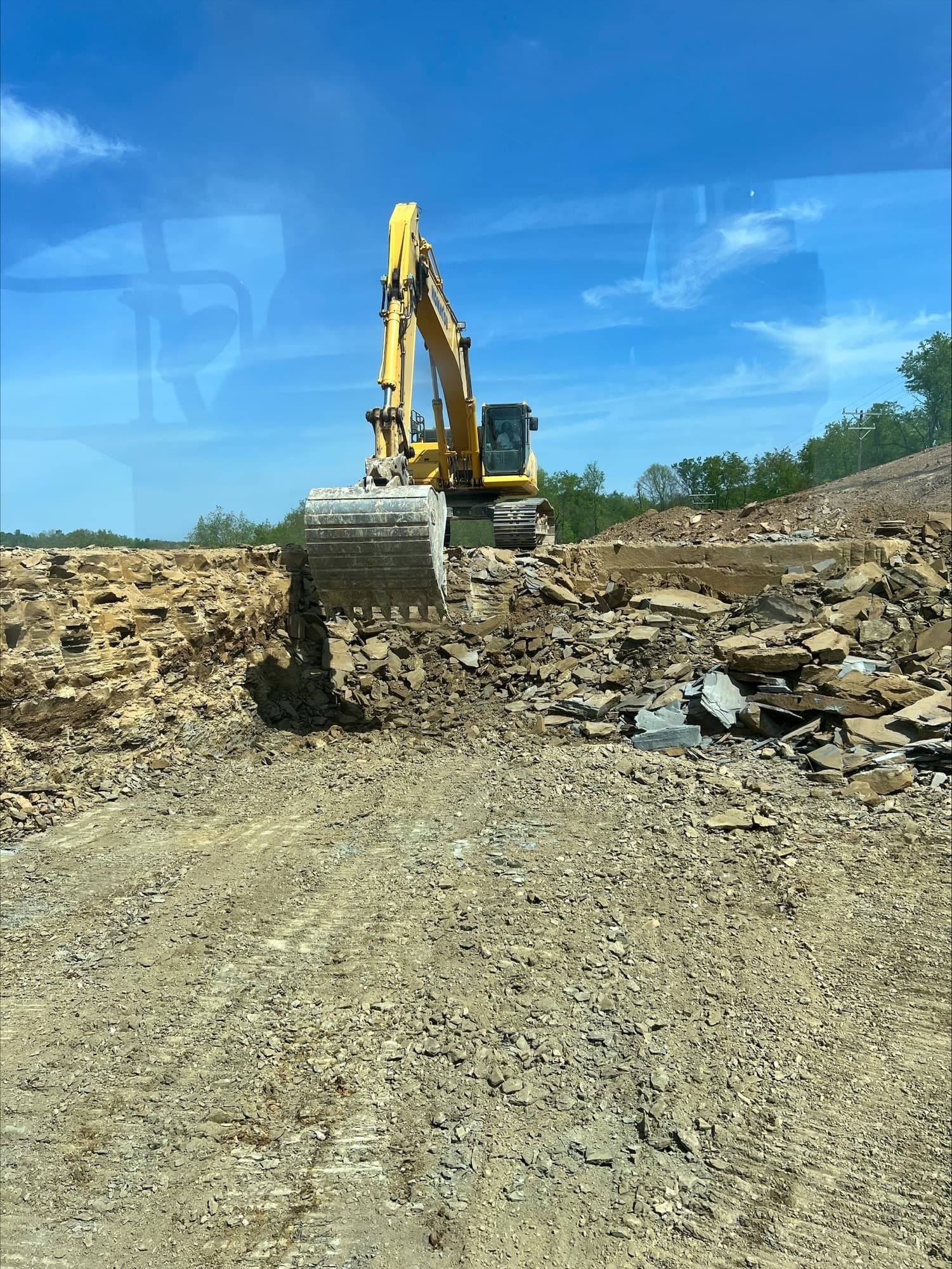
Ground work for an oil and gas site is the civil construction that prepares raw or existing land for a compressor station, well pad, meter station, or pipeline right-of-way. It covers clearing, grading, access road construction, equipment pad preparation, utility trenching, and storm water control. This is engineered work, not generic excavation.
Get it wrong and every phase after it costs more. Get it right and the mechanical crews, the pipe, and decades of operations all sit on a foundation that holds.
This guide walks through what ground work actually involves in the Appalachian Basin, where terrain and geology make it harder than most national playbooks assume.
What Ground Work Means on an Oil and Gas Site
Ground work is civil construction that shapes a site for how it will be used, not just cleared and leveled. The scope runs from the survey through final pad prep, and every decision has to account for operational loads, equipment access, and long-term maintenance.
Site clearing, grading, and pad preparation
Clearing and grading set the elevation and slope that everything else depends on. A pad graded without the mechanical plan in mind creates rework once the equipment shows up.
Grading has to build in compaction, drainage fall, and the bearing capacity the finished pad will need under loaded skids and vessels. According to a civil construction overview from an industry contractor, subgrade preparation and proper compaction are what separate a pad that settles from one that lasts (SETX Industries).
Access roads built for loaded trailers and emergency vehicles
Access roads on an oil and gas site carry loaded trailers, cranes, and emergency vehicles, so they get engineered for weight and turning radius, not passenger traffic. Ohio DNR best management practices call for stabilized construction entrances and road base sized for the traffic the site will actually see (Ohio DNR BMP).
Utility trenching and storm water control from the survey forward
Utility trenching for power and water lines has to align with the mechanical and electrical layout before the first cut. Storm water and erosion control go in during grading, not as a retrofit afterward.
ShalePro performs civil construction in-house alongside mechanical construction, helical piles, and long-term O&M. That means the civil crew designs the site knowing exactly how it will be used for decades, then delivers turnkey from site preparation through maintenance.
What Are the Ground Work Challenges in the Appalachian Basin?
The main challenges are steep terrain, karst geology, and strict water crossing rules, all compounded by freeze-thaw seasons. Pennsylvania, West Virginia, and Virginia hill country brings grades and limited access that generic national contractors routinely underestimate.
Steep terrain and narrow existing roads
Steep grades force more cut and fill, more retaining structure, and more careful slope stabilization than flat-country work. Existing roads frequently need widening or reinforcement before a single piece of heavy equipment ever reaches the site.
Karst geology and subsurface voids
Karst geology with sinkholes and subsurface voids requires geotechnical investigation before grading begins. A void under a pad can undermine a foundation that looked solid on the surface. Investigation up front is cheaper than remediation after a settlement problem shows up under live equipment.
Stream crossings, wetlands, and freeze-thaw seasons
Stream crossings and wetland mitigation fall under overlapping state and federal rules. Seasonal weather adds freeze-thaw cycles, spring mud, and summer flash floods to the schedule.
Proximity to residential and agricultural land demands active dust and noise management. Regional crews who know local geology and permitting authorities plan for these conditions instead of reacting to them.
ShalePro runs seven locations across Pennsylvania, West Virginia, Virginia, and Tennessee, with field offices from Clintwood, VA to St. Marys, PA to Kingsport, TN. The company takes work in New York, Pennsylvania, Ohio, West Virginia, Virginia, Kentucky, and Tennessee, with crews positioned across the field.
How Does Civil Construction Integrate With Mechanical and Pipeline Work?
Civil construction integrates by grading the site around known equipment loads, foundation requirements, and delivery logistics before any dirt moves. The civil crew has to understand what comes next, or the mechanical crews inherit the problems.
Here is how the phases sequence on a well-coordinated project:
- Survey and geotechnical investigation confirm subsurface conditions and set the grading plan.
- Clearing and rough grading establish elevation, slope, and drainage fall.
- Helical pile foundations go in after rough grading, before final pad prep.
- Final pad preparation and compaction bring the surface to bearing spec.
- Fabricated skids and vessels arrive, get set with cranes, and tie into piping.
- Utility trenches, pipeline tie-ins, and commissioning complete the site.
Access roads and laydown areas have to accommodate skids and vessels arriving from the shop, plus the cranes that set them. Utility trenches must align with the mechanical and electrical installation plans, not cross them.
When separate subcontractors hand off between phases, the coordination gaps show up as rework and schedule delays the moment mechanical crews arrive.
ShalePro fabricates skids and piping at its West Alexander, PA shop and yard, then installs and commissions on-site. A single accountable team owns the outcome across civil, mechanical, and pipeline tie-ins. As Sam of Expand Energy put it: "ShalePro has been a strong partner for our operations, consistently executing complex facility construction projects with a strong focus on quality, safety, and schedule."
How Safety and Leading Indicators Protect Ground Work Projects
Safety on a ground work project starts with the first piece of equipment on-site and runs on leading indicators that catch hazards before they become incidents. Excavation, heavy equipment, and steep terrain make civil work one of the higher-hazard phases, which is why OSHA maintains extensive standards for oil and gas extraction operations (OSHA).
Daily Tailgate meetings and Job Safety Analysis
Civil crews hold Daily Tailgate safety meetings and complete a Job Safety Analysis before work begins. These are not paperwork exercises. They put the specific hazards of that day's task in front of the people doing the work.
Field observations that catch hazards before incidents
A dedicated safety and training team runs observations in the field, not just from a corporate office. ShalePro logs more than 500 field safety observations every quarter, tracking near-misses and conditions so hazards get corrected before anyone gets hurt.
Certifications include ISNetworld, Veriforce Preferred, DOT Compliant, and OSHA Compliant, with Veriforce SafeLandUSA trained crews. Cooper Ferko, Director of Safety, leads the department and joined ShalePro in 2019. A leading-indicator culture protects the schedule by preventing the incidents that shut a project down.
Brownfield Ground Work and Operational Continuity
Brownfield ground work is civil construction on an operating site, done without disrupting live production. Expanding a compressor station or adding a well pad next to running equipment demands a different plan than a greenfield build.
Crews stage the job to maintain access for ongoing O&M and emergency response. They manage noise, dust, and vibration near sensitive live equipment throughout.
Tie-ins to existing utilities and drainage have to happen without service interruptions. That takes operational awareness, not only excavation skill. The crew has to know how the site runs before it starts cutting into it.
ShalePro manages more than 2,000 wells, conventional through Marcellus and Utica, and operates hundreds of compressors and pipeline networks. Its civil crews understand what operators need on a running site, backed by 24/7 emergency response with crews positioned across the field.
Storm Water, Environmental Compliance, and Choosing a Contractor
Storm water management is engineered into ground work from the site survey forward, with erosion and sediment control installed as part of grading. Silt fences, sediment traps, and drainage swales go in with the earthwork, not as an afterthought.
Erosion and sediment control from grading forward
Federal new source performance standards and emissions guidelines shape how oil and gas facilities are built and modified (EPA Federal Register). On the water side, sediment control has to hold from the first disturbance until the site is stabilized.
State permitting across PA, WV, and VA
Pennsylvania Chapter 102 erosion control, plus West Virginia and Virginia storm water permits, set strict requirements enforced by agencies like the Pennsylvania DEP. Stream crossing permits and wetland mitigation carry their own timelines that must be built into the schedule before grading.
What to evaluate in a civil contractor
Weigh these factors when choosing a civil contractor for an oil and gas site:
| Factor | In-house crews | Layered subcontractors |
|---|---|---|
| Accountability | One team owns the outcome | Handoffs and finger-pointing |
| Coordination | Civil grades for known next phases | Gaps between phases |
| Schedule risk | Lower, phases aligned | Higher, rework at handoffs |
| Local knowledge | Regional crews know the basin | Often national playbooks |
| Scope | Civil, helical, mechanical, O&M | Civil only |
ShalePro Energy Services is an oil and gas field services company serving the Appalachian Basin from Houston, Pennsylvania, specializing in mechanical construction, pipe fabrication, helical pile installation, and midstream operations and maintenance. Its seven locations and membership in the Appalachian Basin GPA Midstream Association and Virginia Oil and Gas Association keep crews close to state-specific environmental permitting.
Learn more about ShalePro civil construction services and how in-house delivery reduces schedule risk.
Frequently Asked Questions
How long does site preparation take for a compressor station in the Appalachian Basin?
Timelines vary with terrain, geology, and permitting. Steep grades, karst conditions, and stream crossings can add weeks. Chapter 102 erosion permits in Pennsylvania and storm water permits in West Virginia and Virginia shape the schedule before any grading begins, so permitting often drives the calendar more than the earthwork itself.
Does ground work include helical pile foundations for equipment pads?
Helical piles are a separate installation but must be coordinated with civil grading. Piles go in after rough grading and before final pad preparation. ShalePro performs both civil construction and helical pile installation in-house, which keeps the two phases aligned and avoids the handoff gaps that cause rework.
Why choose a single contractor for civil, mechanical, and O&M instead of separate firms?
One accountable team removes the coordination gaps and finger-pointing that occur between subcontractors. The civil crew grades the site knowing what the mechanical and operations teams need next. That reduces rework and schedule risk across the full project, from site preparation through long-term maintenance.
What storm water permits are required for oil and gas civil construction in Pennsylvania?
Pennsylvania Chapter 102 governs erosion and sediment control for earth disturbance activities. Sites may also need stream crossing and wetland permits under state and federal rules. Contractors install silt fences, sediment traps, and drainage swales as part of the grading process rather than adding them later as a retrofit.
Can civil work be performed on an operating well pad without stopping production?
Yes, with careful staging. Crews maintain access for ongoing O&M and emergency response, manage noise and vibration near live equipment, and tie into existing utilities without service interruptions. This brownfield work requires operational awareness alongside construction skill, which is why experience running live sites matters.
Conclusion
Ground work sets the foundation for everything that follows on an oil and gas site. In the Appalachian Basin, steep terrain, karst geology, and layered state permitting make it harder than a flat-country grading job, and the contractor who understands the basin plans for those conditions instead of discovering them.
The strongest outcomes come from teams that own civil, mechanical, helical pile, and O&M work under one roof, so the site is graded knowing how it will be used for decades.
Ready to scope your next site? Contact ShalePro to talk through civil construction for your project. Explore related work in helical pile installation and mechanical construction and pipe fabrication.
Sources
Civil Construction Considerations for Oil and Gas Facilities
Best Management Practices for Oil and Gas Well Site Construction. Ohio DNR
Oil and Gas Extraction. Standards. OSHA
Standards of Performance for New, Reconstructed, and Modified Sources. Federal Register